
The December solstice is on either December 20, 21, 22 or 23. It is called Winter Solstice in the Northern Hemisphere, where it is the shortest day of the year.
December Solstice 2014 in Nova Scotia, Canada is on Sunday, December 21 at 7:03pm AST.
The Sun’s position
The Sun is directly overhead of the Tropic of Capricorn in the Southern Hemisphere during the December Solstice.
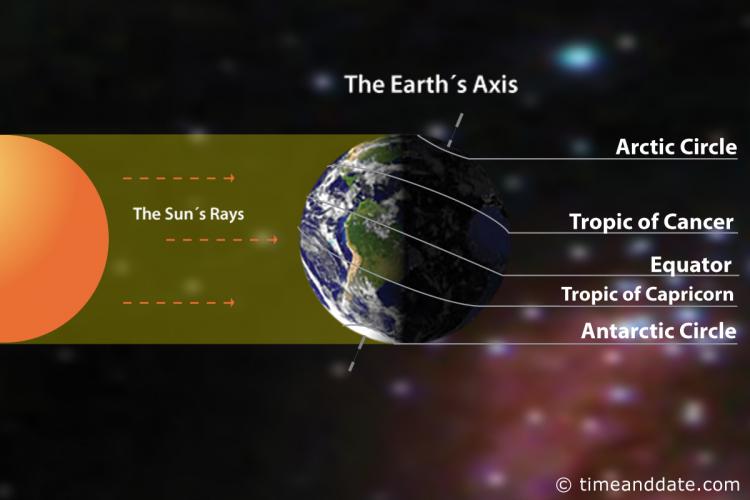
The December Solstice occurs when the Sun reaches its most southerly declination of -23.5 degrees. In other words, when the North Pole is tilted furthest – 23.5 degrees – away from the Sun.
Midnight Sun or complete darkness
Being the longest day of the year, also means that people in the areas south of the Antarctic Circle towards the South Pole will see
the Midnight Sun, i.e. have 24 hours of daylight, during this time of the year.
For people in the Northern Hemisphere, the December solstice marks the exact opposite, the day of the year with fewest hours of daylight. North of the Arctic Circle towards the North Pole there is no daylight at all during this time of the year.
Why do the dates vary?
As with the June solstice, the December solstice’s varying dates are mainly due to the calendar system. The Gregorian calendar, which is used in most western countries, has 365 days in a common year and 366 days in a leap year.
However, the tropical year, which is the length of time the sun takes to return to the same position in the seasons cycle (as seen from Earth), is different to the calendar year. The tropical year is approximately 365.242199 days but varies from year to year because of the influence of other planets. The exact orbital and daily rotational motion of the Earth, such as the “wobble” in the Earth’s axis (precession), also contributes to the changing solstice dates.
The solstices can also be observed by noting the point of time when the sun rises or sets as far south as it does during the course of the year (winter in the northern hemisphere) or maximally north (summer in the northern hemisphere).
December solstice and seasons
It is important to note that Earth does not move at a constant speed in its elliptical orbit. Therefore the seasons are not of equal length: the times taken for the sun to move from the vernal equinox to the summer solstice, to the autumnal equinox, to the winter solstice, and back to the vernal equinox are roughly 92.8, 93.6, 89.8 and 89.0 days respectively. The consolation in the northern hemisphere is that spring and summer last longer than autumn and winter (when the December solstice occurs).
The relative position of the Earth’s axis to the sun changes during the cycle of seasons. This phenomenon is the reason why the sun’s height above the horizon changes throughout the year. It is also responsible for the seasons through controlling the intensity and duration of sunlight received at various locations around the planet.
© 2014 timeanddate.com