

March equinox – equal day and night, nearly
There are two equinoxes every year – in March and September – when the Sun shines directly on the equator and the length of night and day are nearly equal, but not quite.

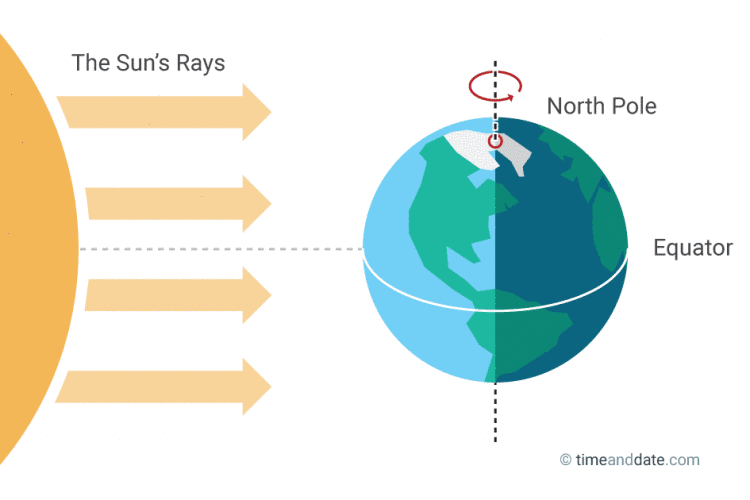
The Earth during the equinox. (Not to scale)
Spring in the north, fall in the south
Equinoxes and solstices are opposite on either side of the equator, and the March equinox is also known as the “spring (vernal) equinox” in the northern hemisphere and as the “autumnal (fall) equinox” in the southern hemisphere.
The Sun crosses equator
The March equinox marks the moment the Sun crosses the celestial equator – the imaginary line in the sky above the Earth’s equator – from south to north. This happens on March 19, 20 or 21 every year.
Spring/March Equinox in Halifax, Nova Scotia, Canada is on
Sunday, March 20, 2016 at 1:30am ADT /04:30 UTC
Why is it called “equinox”?
On the equinox, night and day are nearly exactly the same length – 12 hours – all over the world. This is the reason it’s called an “equinox”, derived from Latin, meaning “equal night”. However, in reality equinoxes don’t have exactly 12 hours of daylight.
What happens on the equinox?
The Earth’s axis is always tilted at an angle of about 23.5° in relation to the ecliptic, the imaginary plane created by the Earth’s path around the Sun. On any other day of the year, the Earth’s axis tilts a little away from or towards the Sun. But on the two equinoxes, the tilt of the Earth’s is neither away from nor towards the Sun. In fact, it is perpendicular to the Sun’s rays, like the illustration shows.
Celebrating new beginnings
The March equinox has long been celebrated as a time of rebirth in the Northern Hemisphere. Many cultures celebrate spring festivals and holidays around the March equinox, like Easter and Passover.
©2016 timeanddate.com
Photo ©bigstockphoto.com/Yastremska