
“Equinox” literally means “equal night”, giving the impression that the night and day on the equinox are exactly the same length; 12 hours each. But this isn’t entirely true.
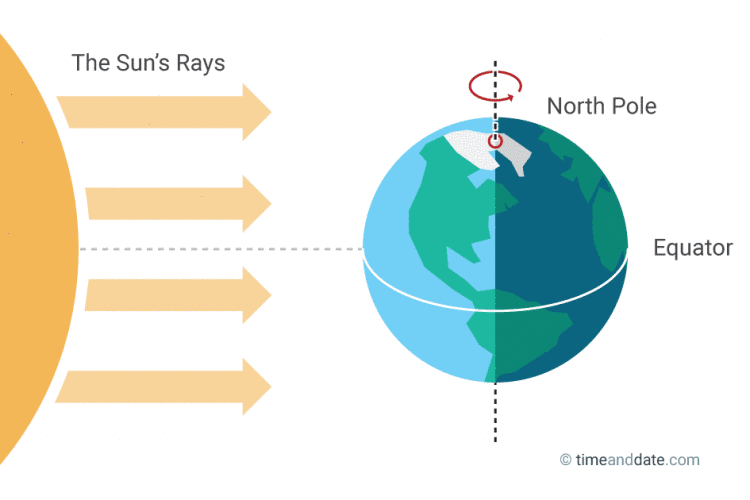
In reality equinoxes don’t have exactly 12 hours of daylight.
“Equinox” means “equal night” in Latin. But even if the name suggests it and it’s widely accepted, it isn’t entirely true that day and night are exactly the same on the equinox all over the world – only nearly.
What is an equinox?
On any other day of the year, the Earth’s axis tilts a little away from or towards the Sun. But on the two equinoxes, the Earth’s axis tilts neither away from nor towards the Sun, like the illustration shows. The equinoxes occur the moment the sun crosses the celestial equator – the imaginary line in the sky above the Earth’s equator. This happens in March and September every year.
More than 12 hours of sunlight
On these two days, the geometric center of the sun is above the horizon for 12 hours, and one might think this would indicate that the length of the day (hours of daylight) would be the same.
However, ‘sunrise’ is defined as the instant when the upper edge of the sun’s disk becomes visible above the horizon – not when the center of the sun is visible. In the same sense, ‘sunset’ refers to the moment the upper edge disappears below the horizon. At both instances, the center of the sun is below the horizon, and therefore the equinox day lasts a little longer than 12 hours.
Atmosphere causes optical illusion
Another reason why the Sun is visible longer than 12 hours on an equinox is that the Earth’s atmosphere refracts sunlight.
Refraction causes the Sun’s upper edge to be visible from Earth several minutes before the edge actually reaches the horizon. In the evening, we can see the sun for several minutes after it has actually dipped under the horizon. This causes every day on Earth – including the days of the equinoxes – to appear at least 6 minutes longer than it actually is.
The extent of refraction depends on atmospheric pressure and temperature. Our calculations assumes the standard atmospheric pressure of 101.325 kilopascal and temperature of 15°C or 59°F.
Latitude determines length of the day
Even if day and night aren’t exactly equal on the day of the equinox, there are days when day and night are both very close to 12 hours.
However, this date depends on the latitude, and can vary by as much as several weeks from place to place. The table shows approximate dates for when day and night are as similar as possible according to latitude.
On the equator, the day and night stay approximately the same length all year round, but the day will always appear longer than 12 hours, due to refraction and the other factors mentioned above.
©2019 timeanddate.com