
Sunday, 27-Mar-2016 / 1pm


There are two equinoxes every year – in March and September – when the Sun shines directly on the equator and the length of night and day are nearly equal, but not quite.
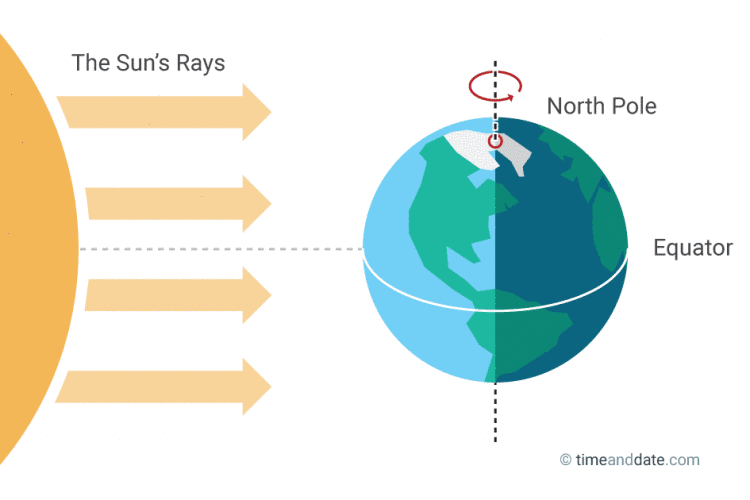
The Earth during the equinox. (Not to scale)
Equinoxes and solstices are opposite on either side of the equator, and the March equinox is also known as the “spring (vernal) equinox” in the northern hemisphere and as the “autumnal (fall) equinox” in the southern hemisphere. Continue reading Spring/March Equinox, 20-Mar-2016@01:30am ADT
January and February have both broken temperature records. Karl Mathiesen examines how much is down to El Niño versus manmade climate change.
Read the full article in ©2016 theeguardian.
2015 recorded one of the strongest El Niños. From November it has been slowly weakening with a transition expected to neutral conditions by next summer, although some models predict El Niño to last for much of 2016. Let’s summarize the main facts.
[©2016 WeatherCast] By historical standards to be classified as a complete El Niño episode, the Oceanic Niño Index (ONI) needs to have a positive ONI greater or equal to +0.5C in the Sea Surface Temperature (SST) for a period of at least 5 consecutive months. Continue reading El Niño is expected to weaken but slowly
Rumor has it that there will be a Total Solar Eclipse coming up next week. And, yes, it’s true. On 8/9-Mar-2016 the moon swings right in front of the sun and will cover it totally for 4 minutes and 9 seconds … But it is all about location, location location!
 So before you get too excited – no, the eclipse cannot be seen at all from Nova Scotia – or the North American continent. It will mainly play out over the North Pacific ocean/Indonesia.
Still interested? Read the articles in Earth Sky or timeanddate.com for more details.
Btw, the next Total Solar Eclipse (at least) partially visible from Nova Scotia will happen next year on 21-Aug-2017. Stay tuned!
A leap year has 366 days, as opposed to a common year, which has 365. Nearly every 4 years is a Leap Year, and we add a Leap Day, an extra – or intercalary – day on February 29.
The next Leap Year is 2016 – this year, so the next Leap Day falls on February 29, 2016. (The last Leap Day was on February 29, 2012.)
Leap Years are needed to keep our modern day Gregorian Calendar in alignment with the Earth’s revolutions around the sun. It takes the Earth Continue reading DYK: What is a Leap Year?
A Supermoon is a full Moon or a new Moon at its closest point to Earth; also called perigee. A Super Full Moon looks around 12 to 14% bigger than its counterpart, the Micromoon.
Super Moon Lunar Eclipse is happening on 27-Sep-2015.
This weekend, the Moon will provide a big, bloody show for those looking up into the night sky. A total lunar eclipse — sometimes referred to as a blood moon due to the Moon’s dark red glow — is scheduled to begin at 9:11pm ADT on Sunday.
[Watch the Lunar Eclipse live here …]
But this eclipse is particularly special, because it’s happening on a night when the Moon will also be a supermoon. That’s when a full moon occurs on the same night of the Moon’s perigee, or the time when the Moon is closest to Earth. The Moon has an elliptical orbit around our planet, so its distance from Earth doesn’t stay the same. When at perigee, the Moon looks up to 14 percent larger and 30 percent brighter than it does when it’s at apogee (its farthest point from Earth). Continue reading Super Moon Lunar Eclipse happening this Sunday


