
This year – 2016 – is a Leap Year – which means that February will have 29 days. Do you know why?
Watch this short clip which will give you some insights as of why.
©2014 Nil.
Also read our post here.

A leap year has 366 days, as opposed to a common year, which has 365. Nearly every 4 years is a Leap Year, and we add a Leap Day, an extra – or intercalary – day on February 29.
The next Leap Year is 2016 – this year, so the next Leap Day falls on February 29, 2016. (The last Leap Day was on February 29, 2012.)
Leap Years are needed to keep our modern day Gregorian Calendar in alignment with the Earth’s revolutions around the sun. It takes the Earth Continue reading DYK: What is a Leap Year?
Daylight Saving Time (DST) ends in USA and Canada !!!
On Sunday, November 1st, 2015, at 2:00h (2am) clocks will be set back one hour as Daylight Saving Time (DST) ends in most of the United States, Canada and Mexico’s northern border cities.
Why do we have twenty four hours in a day–as oppose to twenty, or twelve, or any other division of time? To uncover the mystery of the twenty-four hour day we need to take a trip back to ancient Egypt.

While many cultures around the world use a base-10 system (largely in part because they began their exploration of mathematics by counting their ten fingers), ancient Egyptians used a base-12 system. Instead of counting their individual digits, Egyptians instead counted the knuckles of each each finger using their thumbs as pointers (four fingers on each hand, three knuckles per hand, twelve total units). Continue reading Did you know: Who Divided The Day Into 24 Hours?
Daylight Saving Time (DST) is often misspelled “Daylight Savings”, with an “s” at the end. Other common variations are “Summer Time”and “Daylight-Saving Time”.
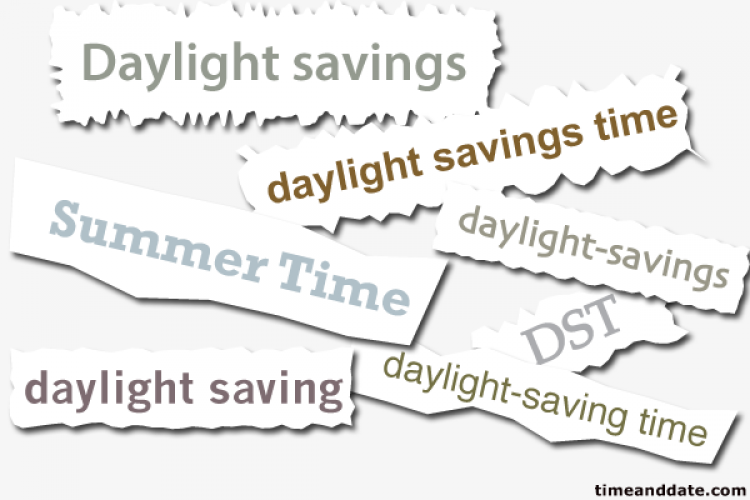
Setting our clocks one hour forward in the spring is often referred to as “Daylight Savings Time” even though “Daylight Saving Time” is the correct spelling. Continue reading Daylight Savings Time or Daylight Saving Time
Daylight Saving Time (DST) starts in USA and Canada !!!
On Sunday, March 8, 2015, most of the United States, Canada, and Mexico’s northern border cities will start Daylight Saving Time (DST). At 2:00h (2am) clocks will be set forward one hour!
In the family of planets that make up our solar system, Venus is a peculiarity among peculiarities. The roughly Earth-sized but scorching planet has an average surface temperature of 462C (864F) and an atmosphere composed almost entirely (96.5%) of carbon dioxide.

As far as planetary extremes go, Continue reading Did you know: Which Planet’s Days Are Longer Than Its Years?
Remember: Sunday, November 2, 2014
Daylight Saving Time (DST) ends in USA and Canada !!!
On Sunday, November 2, 2014, at 2:00 (2am) clocks will be set back one hour as Daylight Saving Time (DST) ends in most of the United States, Canada and Mexico’s northern border cities.

